


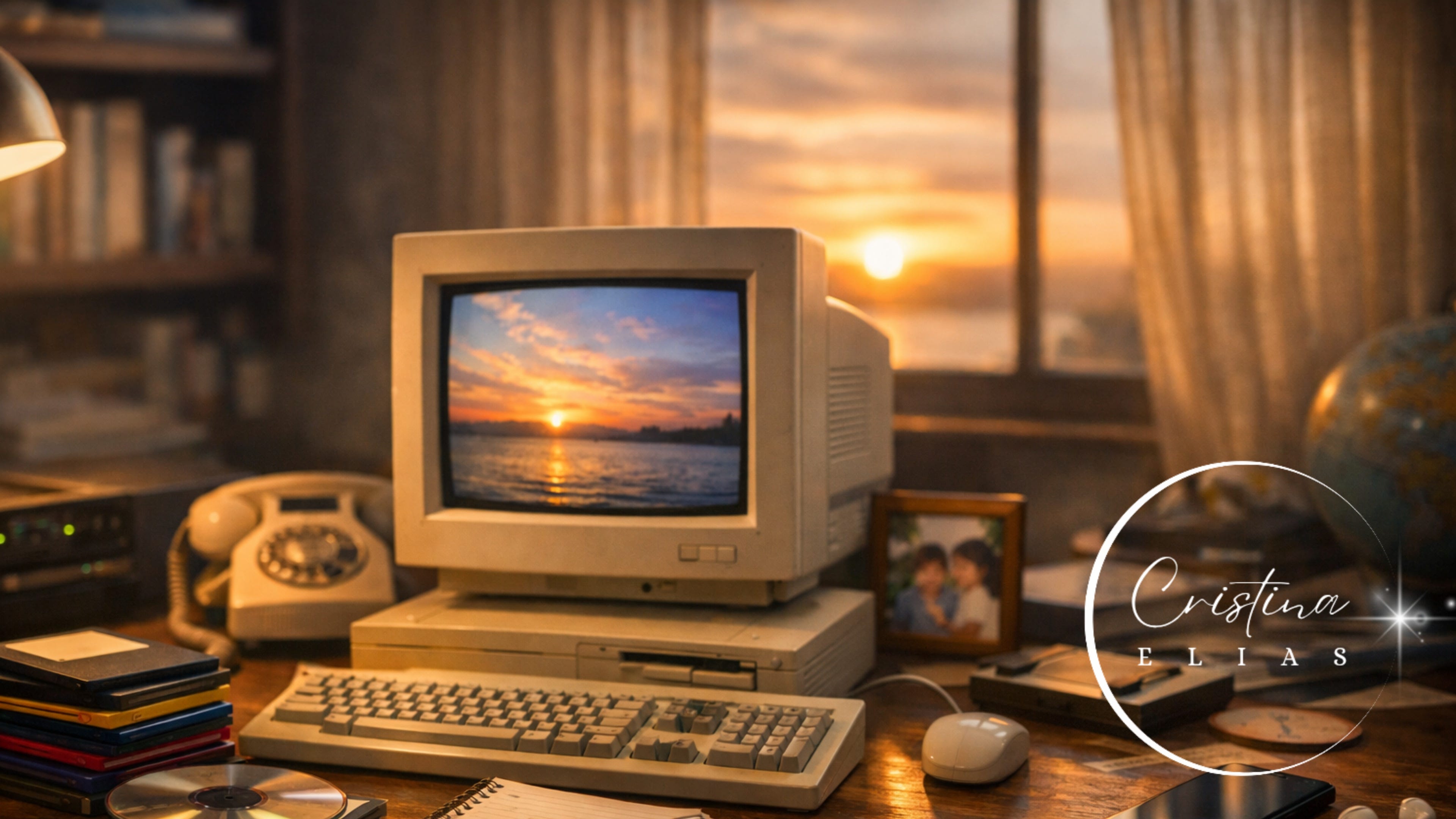
Sometimes a memory appears without warning.
Not a dramatic one. Not a special occasion.
Just a small sensory moment — the metallic breathing sound of the modem, the feeling of coming home and nobody being able to reach you, the certainty that once you left a place, you were truly gone from it.
And suddenly you realize something unsettling:
That way of living does not exist anymore.
Not your childhood specifically.
The structure of reality itself.
This is a letter to millennials — the generation that did not simply grow up in a world, but grew up while the world itself was changing its operating system.
We were not raised in the same reality we now live in
When we were children, life had natural endings.
Afternoons ended when school ended. Evenings ended when darkness settled. Conversations ended when you walked away from someone, and plans required commitment because there was no continuous correction afterwards. If someone was not at home, they were simply unreachable. You could not negotiate presence in real time.
Information existed somewhere else. You either knew something, or you asked, or you waited, or you did not find out that day. Questions could remain open for days without discomfort. Memory lived inside people, not devices. Boredom existed, and strangely, it held space for imagination.
We never thought of this as peaceful because we had nothing to compare it to. It was simply reality.
Then reality started updating quietly
There was no historical announcement.
No moment anyone told us we were crossing an era.
First, a computer room appeared in school. It was not central — it was a place you visited. We took turns, opened simple programs, drew shapes, played cautiously, and left. Nobody thought this would become the environment of adult life.
Then came the internet, slowly and loudly. The connection sound is shared memory among millennials — a strange mechanical conversation between two machines negotiating existence. You had to disconnect the phone line to enter it. Being online required intention.
Later came mobile phones with messages that cost money. You counted characters before sending them. Words had weight because communication had a price.
Every step felt small, practical, convenient. And because each step was small, we never noticed the accumulation.
We did not see the moment the old world ended
There was never a day someone announced:
From now on, you will always be reachable.
From now on, knowledge will be instantly available.
From now on, part of your identity will exist outside your body.
Yet all of it became true.
At some point maps disappeared into pockets.
Phone numbers disappeared from memory.
Waiting disappeared from daily life.
Silence disappeared from time.
Life did not suddenly accelerate — it lost its edges.
Evenings no longer closed themselves. Conversations continued across spaces. Presence no longer required location. The background turned permanently on.
And we adapted so naturally that we only notice the scale years later, when a memory returns and the body reacts before the mind understands why.
This is not nostalgia. It is recognition.
Why millennials feel this differently
Generations before us remember stability that was later modernized.
Generations after us remember only continuous connection.
Millennials remember transition.
We calibrated our minds in a world of pauses and built our adult lives in a world without them. We learned patience before instant answers, memorization before search engines, meeting before messaging, absence before constant availability.
So inside us exist two maps of reality at the same time.
We understand why older people feel overwhelmed by the speed of change, and we understand why younger people feel perfectly at home inside it. We are fluent in both languages, but native in neither.
And this creates a strange position: we often become translators without choosing to.
The role we keep stepping into
In families, workplaces, and relationships, many millennials instinctively connect perspectives.
We explain technology to those who did not grow up with it, and we explain human nuance to those who never lived without it. We slow conversations enough so they regain meaning, and we modernize systems enough so they function.
Not because we are wiser. Because we remember friction.
We know what actions felt like before everything optimized itself. When a system becomes efficient but empty, something inside us tries to restore context.
We are not resisting progress. We are trying to make it inhabitable.
The emotion behind the memories
When an old sound, object, or small moment moves us deeply, it is rarely about the object itself.
It is the nervous system recognizing a mode of living:
a time when attention had location, when communication required presence, when life paused without effort.
We did not just gain technology in twenty years. We crossed a civilizational boundary while becoming ourselves.
For most humans in history, the world they were born into resembled the world they left. Millennials were born analog and became digital adults without ever stepping outside their own lifetime.
Sometimes the mind realizes the scale only afterward — and emotion follows understanding.
Perhaps this gives us a quiet task
Not to reject modern life. Not to romanticize the past. But to carry continuity forward.
To remember that connection is not identical to presence, that information is not identical to understanding, and that speed is not identical to meaning.
Many millennials feel drawn toward clarity, intentional living, and systems that serve humans rather than replace them. This is not coincidence. It reflects the position we occupy in history: we remember a rhythm that once existed automatically, and now must be created consciously.
We stand between two human tempos — one that ended naturally and one that never turns off.
And maybe our role is simple: to help the modern world remain livable for the human mind.
If this feels familiar, nothing is wrong with you. You are not just remembering childhood. You are remembering the last time reality paused on its own — and learning how to create that pause again inside a world that no longer provides it automatically.