


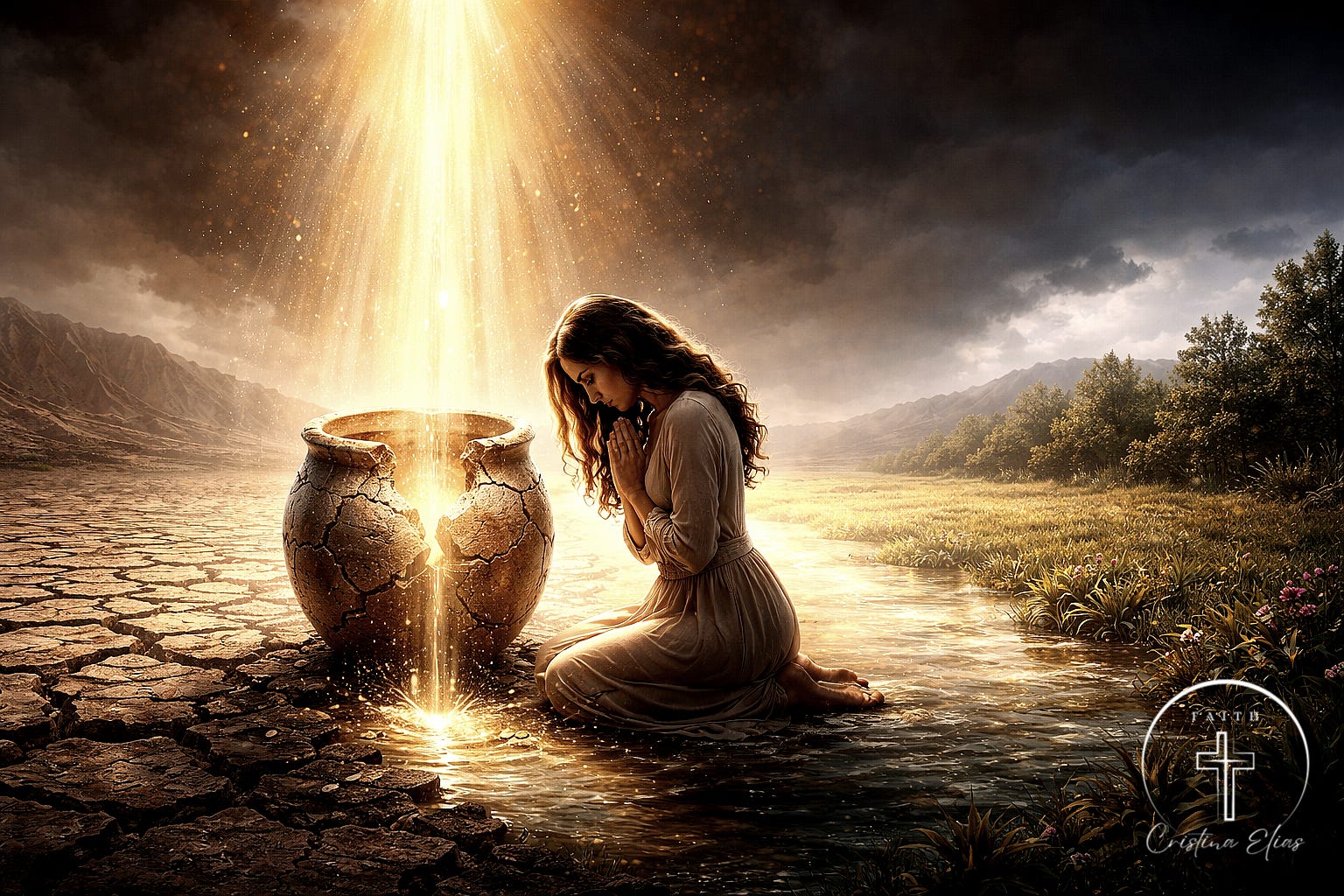
There are questions that feel sacred the moment they rise within the heart—questions that sound humble, almost reverent, as if they are bringing us closer to God… yet quietly, almost invisibly, they keep us standing at a distance from the very truth we long to touch.
In a quiet moment, when everything slows down and the noise of the world softens, a thought begins to form—not loud, not aggressive, but persistent, almost tender in its tone:
Am I worthy of God?
It sounds like devotion.. It sounds like honesty.. It even sounds like humility..
And yet, if we stay with that question long enough, something deeper begins to unfold—something that gently reveals that this question, however sincere it may feel, is built on a foundation that was never meant to carry the weight of your identity.
Because “worthiness” belongs to the language of performance.
It belongs to systems where love is measured, evaluated, and—at least in part—earned. But relationship, real relationship, does not grow from performance. It grows from belonging.
A child does not wake up after making a mistake and wonder whether they are still a child. Even in failure, even in distance, even in moments of brokenness, the identity remains untouched. What may be affected is closeness, trust, intimacy—but never the origin of the relationship itself.
And this is where something profoundly healing begins to take shape.
If God is truly Father—not as a concept, but as a living reality—then the foundation of that relationship cannot be worthiness, because worthiness fluctuates. It rises and falls with behavior, with perception, with internal states that are never fully stable.
But Scripture speaks a different language, one that is quieter, yet far more anchored. It speaks of adoption, of being brought into a relationship that precedes performance entirely: “See what great love the Father has lavished on us, that we should be called children of God—and that is what we are” (1 John 3:1).
Not what we might become, not what we could earn, but what we already are. Now the question begins to shift, not because it is forced to change, but because it gently dissolves under the weight of a deeper truth: if you already belong, then you are not standing outside, trying to qualify for entry. You are not negotiating your place at the table. You are not waiting for approval to come closer. You are already inside the house. And from within that place, life begins to look different.
The questions are no longer rooted in fear of exclusion, but in the desire for alignment:
Not “Am I worthy?” but rather “Am I living in the truth of what has already been given?”
Not “Do I belong?” but “Am I allowing myself to experience the closeness that is already available to me?”
There is a quiet strength that emerges when identity is no longer under negotiation. A stillness that does not need constant reassurance. A grounded sense of being that is not shaken by every internal or external fluctuation.
And yet, even within this belonging, there are seasons that feel confusing—moments where, instead of fullness, there is emptiness; instead of clarity, there is silence; instead of closeness, there is a kind of aching distance that is difficult to explain.
It is here that many hearts begin to wonder again.
Something must be wrong.
Something must be missing.
Perhaps God has stepped back.
Perhaps something has been lost.
But what if that interpretation, too, is only part of the story?
What if the emptiness is not a sign of absence, but a form of preparation?
There is a quiet pattern revealed throughout Creation and Scripture: that God often enlarges capacity before He fills it. That what feels like loss is sometimes the gentle, even painful, process of making space. The human heart, in many ways, is like a vessel. And a vessel can only carry according to its current capacity. If more is to be received—more depth, more presence, more of God Himself—then something within must first be stretched. And stretching does not feel like abundance.
It feels like emptiness.
It feels like something familiar has been removed.
It feels like standing in a space that echoes.
Scripture whispers: “Enlarge the place of your tent… stretch your tent curtains wide” (Isaiah 54:2). Not as a command rooted in pressure, but as an invitation into expansion—a preparation for something greater than what was previously held.
So what if nothing has been taken from you?
What if, instead, space is being created within you?
Space for a deeper indwelling.
Space for a fuller presence.
Space for a relationship with God that is no longer experienced only around you or above you—but increasingly within you, with weight, with depth, with quiet permanence.
Both the question of worthiness and the experience of emptiness begin to lose their power to destabilize.
Because one was never the right foundation to begin with. And the other was never meant to be interpreted as absence.
You are not becoming worthy of God. You are awakening to the reality that you already belong.
And those spaces within you that feel stretched, quiet, or even unbearably empty… may not be signs of distance at all, but the very places being prepared for a deeper, fuller, more intimate indwelling than you have ever known.
Not less of Him. But more room for Him. ✨