


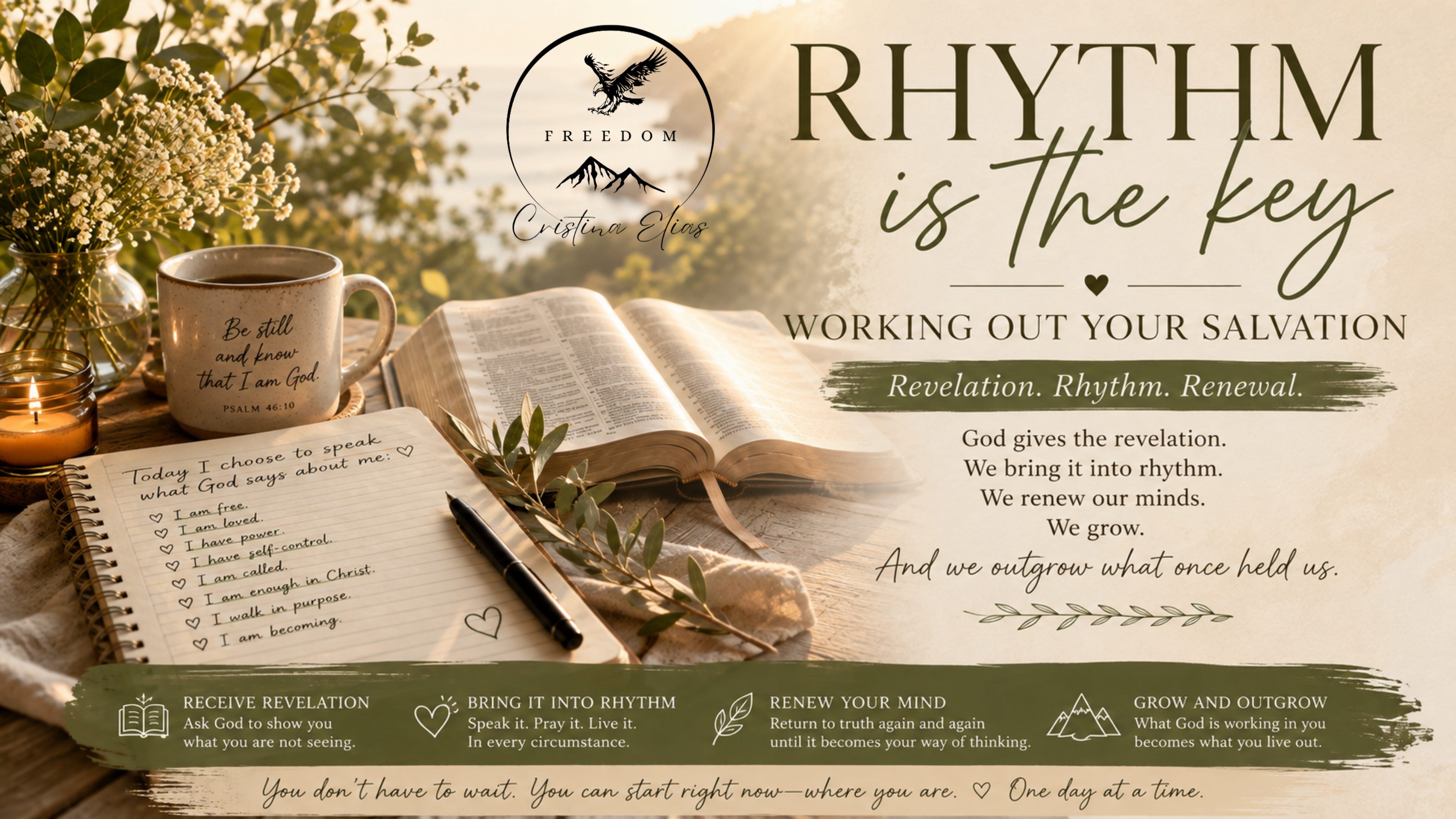
There has been a question I have been bringing before God for quite some time, especially in relation to those things in our lives that we know should no longer have power over us, yet somehow continue to do so. It can be an addiction, a habit, a repeated pattern, or anything that keeps bringing us back to the same place even though we know there is more available to us in God. My question was not simply, “God, how do I overcome this?” It went deeper than that. I wanted to understand where my responsibility actually begins and ends. When do I know that I have not pushed enough, that I am not using all the power God has already given me, and that what I call waiting on God is actually me refusing to exercise what He has placed in my hands? But then, on the other side, when do I know that I have done what belongs to me and need to take my hands off the situation? We speak so easily about surrendering something to God, but what does taking your hands off actually look like when you still have to wake up the next morning and live with the same circumstances, the same body, the same thoughts and sometimes the same temptation? When is pushing an expression of faith and discipline, and when has it become striving? When is surrender really trust, and when is it simply passivity dressed in spiritual language?
I realized that being caught between these two possibilities can itself become a form of stagnation. I can push for a while, then decide I should surrender; I can surrender for a while, then wonder whether I am actually supposed to fight; I can become determined again, then question whether my determination is me trying to do God's job. There can be tremendous internal movement without any actual movement forward. James says that the double-minded person is unstable in all his ways (James 1:8), and suddenly I could see how relevant that is here. If I am constantly pulled between opposite directions because I do not know which one is true for the place where I am standing, the problem is no longer simply whether I am strong enough to overcome. The problem is that I do not have clarity about where my strength should be applied. And this is where the first part of the revelation became almost shockingly simple: whichever answer is right, I need God. If I need to push, I need Him to reveal that to me. If I need to take my hands off, I need Him to reveal that to me. If I am not using something He has already given me, I need Him to show me. If I am trying to force something that belongs in His hands, I need Him to show me that too. I do not merely need more power; I need wisdom and revelation concerning the power I have been given and how I am supposed to walk in it.
This made Paul's prayer in Ephesians 1:17–18 much more alive to me, where he prays that God would give us the Spirit of wisdom and revelation and enlighten the eyes of our understanding. There are things we cannot move through simply by pushing harder because what is missing is not necessarily strength; sometimes what is missing is sight. Hosea 4:6 says that God's people are destroyed for lack of knowledge, and there is something deeply practical in that. I can have resources available to me and still not know how to use them. I can have truth and still not understand how it applies to the place where I am standing. I can even be trying very hard and still be moving in the wrong direction. So my prayer changes from merely, “God, take this away,” into something deeper: “God, show me. Give me wisdom. Give me revelation. Show me what I am not seeing here. Show me what You have already placed within me and how I am supposed to use it. Show me where I need to stand and where I need to release. Show me where I am stagnating because I keep moving between two directions.” Whatever God reveals, I then need His grace to walk through that revelation, because revelation is not given merely so that I can understand something intellectually. It gives me something by which I can actually move.
And this is where I realized that what was happening to me now was not an isolated revelation at all. It was another layer of revelation built upon things God had already revealed before. Revelation can be progressive. God shows us something, we walk with what we can see, and then another piece opens. The first revelation does not become less real simply because we later see more. It becomes part of a larger picture. Sometimes I think we expect revelation to arrive as one complete package in which God explains everything from beginning to end, but growth does not always happen that way. Sometimes He gives us something we are capable of carrying now, and as we walk with it, what He showed us becomes the foundation from which we can see the next thing. That is exactly what happened here. Some time ago, I had a dream, and when I woke up one sentence remained clearly in my mind: Rhythm is the key. That was already revelation. At that time, I understood it primarily in connection with getting physically in shape. If I eat according to my goal for two or three days and then completely reverse it during the next two or three, I have not created a rhythm that can transform my body. If I restrict calories and then eat them all back, I may have experienced several disciplined days, but I have still ended up where I started. The same principle applies to training. One intense workout followed by long inconsistency does not produce what repeated training produces. It is not merely the intensity of an individual action that creates transformation; it is the direction maintained through rhythm.
That revelation was complete enough for the place where I received it, but now it opened further. Suddenly “rhythm is the key” connected with a Scripture I already knew: “Work out your own salvation with fear and trembling; for it is God who works in you both to will and to do for His good pleasure” (Philippians 2:12–13). I began to understand the relationship between those two parts differently. God is working in me, and I am called to work out what He is working in me. This is not about earning salvation; salvation is God's gift by grace through faith, as Ephesians 2:8–9 makes clear. It is about what happens with the life He has already placed within me. If God has put something in me, then there is a process through which what is inward becomes increasingly expressed outwardly. There is something to grow into, something to exercise, something to become established in. And suddenly the revelation about rhythm was no longer only about my physical body. What if rhythm is also one of the ways through which I work out what God is already working within me?
That is when Romans 12:2 became part of the same revelation: “Be transformed by the renewing of your mind.” Transformation and renewing are connected. The mind does not merely need to hear truth; it needs to be renewed by truth, and renewal means that I return to what God has revealed until my thinking becomes increasingly aligned with it. If I can understand physically that doing something in one direction for several days and then reversing it for several days can keep me in the same place, why would I expect the opposite principle to work spiritually? I cannot receive something from God in prayer, speak according to that truth for a moment, and then spend the rest of my life repeatedly speaking the exact opposite over myself without that contradiction having an effect. If God reveals freedom to me and I continually describe myself as powerless before the thing that once held me, what rhythm am I creating in my mind? If God reveals self-control to me, but every time an appetite rises I tell myself that I cannot help myself, what am I repeatedly rehearsing? If God reveals who I am, but every changing circumstance is allowed to rename me, then I may have received revelation without yet learning how to live in rhythm with what was revealed.
This is where the words I speak over myself become far more important than simply making positive declarations. I am not talking about pretending that a struggle does not exist or using words as if they were magic. If I am experiencing temptation, I do not need to lie and say there is no temptation. If fear is present, I do not need to pretend I cannot feel it. But I also do not have to allow the presence of temptation to become a confession of bondage or the presence of fear to become a confession that fear governs me. I can say, “This temptation is here, but I am free. I have self-control. I do not have to obey everything that speaks to me.” I can feel fear and still say, “Fear does not govern me. God has given me power, love and a sound mind” (2 Timothy 1:7). I can stand in a circumstance that looks completely contrary to what God has revealed and still refuse to allow that circumstance to become the highest authority concerning who I am. Proverbs 18:21 tells us that death and life are in the power of the tongue, and Jesus says that out of the abundance of the heart the mouth speaks (Luke 6:45). Our words reveal what we are agreeing with, and they also become one of the places where we deliberately practice returning our minds to truth.
This is where the revelation becomes incredibly practical, because I do not have to wait until the struggle is gone before I can begin. In fact, the circumstance in which the opposite is speaking is exactly where I have an opportunity to bring truth into rhythm. If I know that I am free, then I speak from freedom when bondage speaks. If I know that I have self-control, then I bring my mind back to self-control when appetite speaks. If God has revealed His love to me, then rejection becomes the place where I refuse to let rejection redefine me. If He has revealed courage, then I do not have to wait until fear disappears before I begin agreeing with courage. I take what God has revealed and I begin carrying it through the different circumstances of my life. I say it when I wake up. I say it when I am strong. I return to it when I am weak. I return to it when the opposite thought comes. I return after failure rather than allowing failure to become a new identity. I pray from it, I speak from it, and increasingly I make decisions from it. This is rhythm—not perfection, not one enormous spiritual moment, but repeatedly bringing myself back into agreement with what God has revealed.
And this is what made the phrase “work out your salvation” suddenly so alive to me, because working something out implies that there is something within me that is being exercised into expression. What if every time I return to truth, I am exercising something? What if every time I say, “I am free,” in the very situation where I once automatically agreed with bondage, something is growing? What if every time I choose to speak from love rather than from the reaction that comes naturally in the moment, love is being exercised? What if every time I stand in what God has revealed despite what I feel, I am building spiritual strength in the same way that resistance develops physical strength? Hebrews 5:14 speaks about mature people whose powers of discernment have been “trained by constant practice,” and Paul tells Timothy to train himself for godliness (1 Timothy 4:7). There is nothing unspiritual about growth requiring practice. God being the source of the life does not eliminate the process through which that life matures.
A child helped me understand this even more clearly. We do not become angry with a child because she cannot do everything immediately. We do not question whether life is truly inside her because she cannot yet walk, lift, speak or function with the capacity of an adult. The life is already there, but the capacity of that life grows. The child has muscles before those muscles become strong. She has legs before she learns to walk. She has a voice before she learns to communicate everything she carries inside her. And perhaps I have sometimes expected the spiritual life God has placed within me to function at full maturity simply because it is genuinely there. What if the power is there, but the power has to grow in expression? What if freedom is there, but I have to learn how to walk in freedom? What if self-control is a fruit of the Spirit, but I become increasingly established in it by exercising it? We do not despise a child for growing; we understand that growth is what living things do.
And growth usually does not feel spectacular while it is happening. That may be one of the reasons we so easily abandon the rhythms that are actually changing us. A child does not feel herself becoming taller every night. You do not feel every microscopic process through which muscle repairs itself after training. Sometimes growth hurts, sometimes it is uncomfortable, and much of the time it feels like nothing at all. It is simply day after day. But what if the same is true spiritually? What if I do not need a “wow” feeling every time I pray for prayer to be feeding something within me? What if every time I confess what God has revealed, every time I renew my mind, every time I refuse to let the old identity become my language again, every time I return to truth after falling out of rhythm, I am growing even when I cannot yet see the accumulated result? The absence of a dramatic feeling does not mean the absence of growth.
This completely changes the way I look at the things I am trying to overcome, because perhaps I have spent too much time staring at the chain and not enough time understanding what God is growing inside the person wearing it. I keep asking, “When will this finally fall off? When will this addiction no longer speak? When will this pattern disappear? When will I finally become free enough that I do not have to deal with this anymore?” But what if part of the answer is that I am becoming stronger? What if I keep bringing freedom into rhythm until the person who once automatically surrendered to an urge now knows how to stand while the urge passes? What if I keep bringing truth into rhythm until the lie that once immediately convinced me meets a mind that has spent months being renewed? What if I keep speaking from the identity God has revealed until the old identity begins to sound foreign coming out of my own mouth? Jesus says, “If the Son sets you free, you will be free indeed” (John 8:36). The source of freedom is Christ. But perhaps working out that salvation includes growing in our ability to live from the freedom He has already given.
And this is where something beautiful happened in my understanding: instead of waiting only for the chain to fall, I can grow until I have outgrown what once held me. That does not diminish God's power; it reveals His power working in a human life. God works in me, and I work out what He is working in me. His grace does not make my participation unnecessary; His grace makes my participation possible. The power does not originate in my repetition, but repetition gives what He has revealed a rhythm in my life. The truth does not become true because I confess it, but confession continually brings my mind back into agreement with what is already true. And slowly, perhaps almost invisibly at first, the person living from that truth changes. What once felt impossible becomes possible. What once required enormous conscious effort becomes increasingly natural. What once moved me immediately may still speak, but it no longer moves me with the same authority. I have not merely learned a better sentence. I have grown.
So what do I actually do with this revelation today? I begin exactly where I am. If I am going around in circles in an area of my life and I do not know whether I need to push, release, resist, wait or change direction, I ask God for revelation. I ask Him to show me what I cannot currently see, to give me wisdom concerning what He has already placed within me, to expose where I am stagnating and to show me what truth I need in this particular place. And then I work with what He reveals instead of immediately demanding the entire map. Perhaps He has already revealed something to me that I have never brought into rhythm. Perhaps I already know, “I am free,” but I have not practiced speaking and choosing from freedom when the opposite appears. Perhaps I already know that I have self-control, that I am loved, that I am not powerless, that I belong to Him, but those truths still live mostly in my theology rather than in the language with which I meet ordinary circumstances. Then that is where I begin. I take what God has revealed and deliberately bring it into the rhythm of my thoughts, my words, my prayers and my decisions.
And when another revelation comes, I do not have to throw the first one away. I allow God to build upon it. That is what happened to me. “Rhythm is the key” was revelation. Understanding that principle through my physical life was revelation. Then “work out your salvation” opened another layer. The renewing of the mind connected with it. The words I speak over myself suddenly became part of that process. Then growth itself became clearer, and finally freedom began to look different. These were not disconnected spiritual thoughts that I needed to organize into a nice teaching. They were revelations flowing into one another, each one allowing me to see further than I could see before. That is why I now understand revelation itself as something in which we can grow. God can show me something truly today without today being the limit of everything He will ever show me about it. I walk with the light I have, and as I walk, He can illuminate what comes next.
Perhaps this is why the sentence God gave me before I understood any of these connections still sits at the center of the whole thing: rhythm is the key. Revelation gives me light, but rhythm allows me to live in the light I have received. Through rhythm, I renew my mind with what God has shown me. Through that renewed mind, my words and choices begin to align. Through repeated alignment, what God has placed within me is exercised and grows. And as I grow, the things that once governed me begin to lose their ability to govern me. I do not have to wait until I am completely free from every struggle before I begin living as the person God has revealed me to be. I can begin becoming that person right in the middle of the struggle, because the struggle itself gives me somewhere to practice what has been revealed.
That brings me back to the question with which all of this started, but I no longer hear the question in the same way. “God, should I push harder, or should I take my hands off?” is no longer a question I need to solve with one answer that applies to everything. What I need is God. I need revelation for the place where I am standing, and then I need the grace to walk according to what He reveals. I need to stop being double-minded once He has given me direction and bring that truth into rhythm instead. I can renew my mind with it in every circumstance, speak according to it when the opposite is shouting, make choices that agree with it, and continue doing so long enough for what God is working within me to become increasingly visible through me. Then, when He gives me the next layer of revelation, I walk with that too.
This is what working out my salvation has begun to mean to me in a way it never did before. God is not asking me to manufacture the life He has promised. He is teaching me to grow in the life He has already given. Revelation shows me what is there and where I need to move; rhythm gives that revelation a place to become established; renewing my mind keeps bringing me back into agreement with it; and through that repeated agreement, I grow. Perhaps some chains will fall in a moment, and perhaps others will lose their hold as the person inside them grows beyond the place where they once had authority. Either way, I do not have to spend my life staring at the chain. I can turn my attention toward God, receive what He reveals, and begin living from it today.
And perhaps this is the simplicity I was searching for all along. I do not have to know everything before I can move. I need the revelation God has given me for today, and I need to bring it into rhythm. Tomorrow I return to it. When circumstances contradict it, I return to it. When I fall, I return instead of making the fall my identity. When I grow, I remain open to the next thing God wants to reveal. Revelation upon revelation, truth brought into rhythm, the mind renewed, the inner person strengthened, until what God has been working within me becomes the way I naturally live. Because revelation may illuminate something in a moment, but becoming established in what has been revealed happens through rhythm—and somewhere inside that rhythm, without always noticing exactly when it happened, I may discover that I have become too large for the chains that once seemed large enough to hold me.