


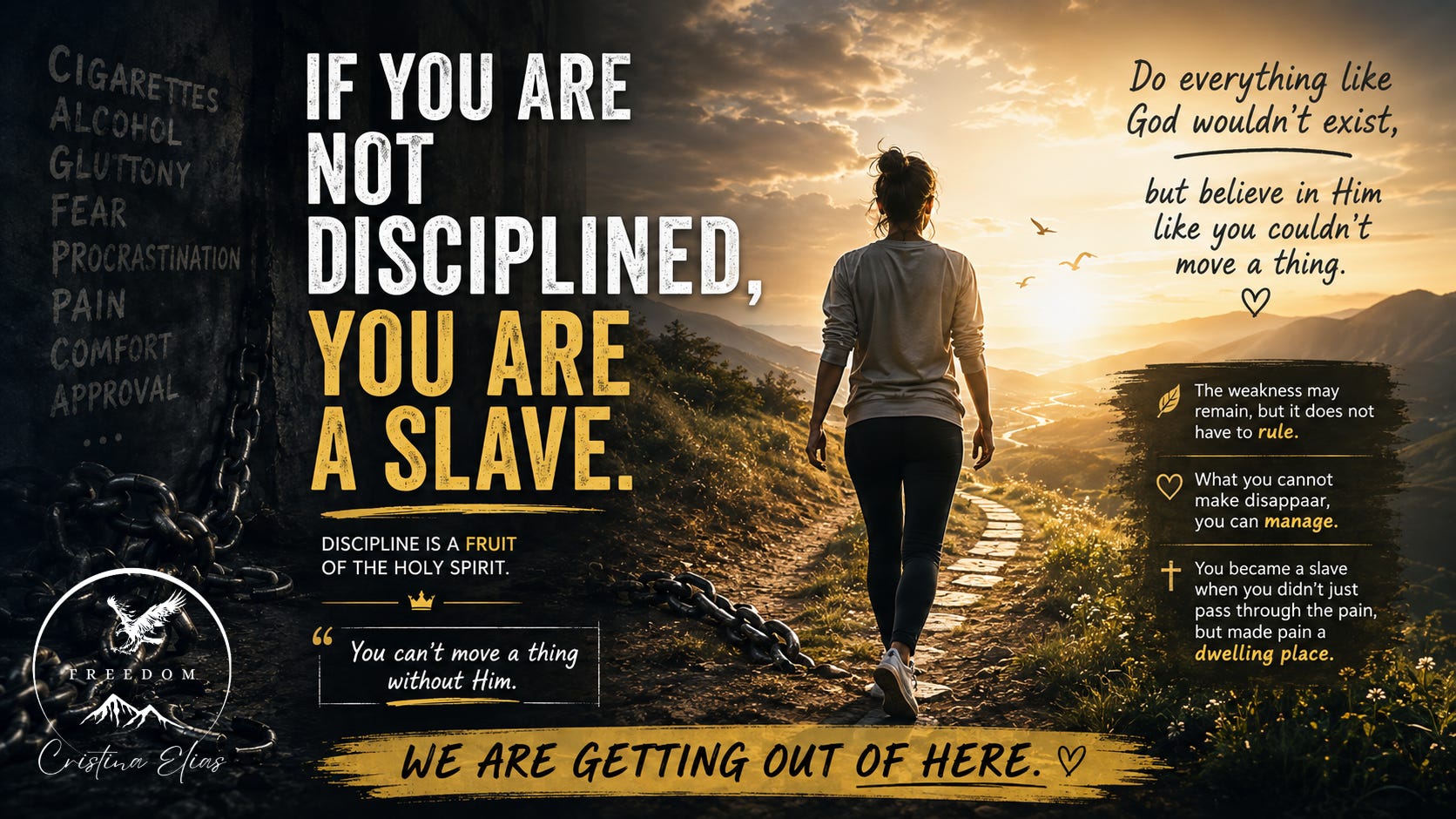
If You Are Not Disciplined, You Are a Slave
This is a bold statement, and I know it is. You may call it weakness. You may call it addiction, fear, procrastination, gluttony, avoidance, comfort, trauma, habit, lack of motivation, or simply “the way I am.” And some of those words may explain very accurately how the problem began.
But perhaps there comes a point when we need to stop naming something only by what caused it and begin naming it by what it is doing to us.
If there is something you do not want to do, yet you repeatedly find yourself doing it, something has gained power over your behavior. And if there is something you genuinely want to do, know you should do, have decided to do, and yet continually find yourself unable to follow through, something is interfering with your freedom.
Paul described this contradiction with painful precision: “For what I want to do I do not do, but what I hate I do.” — Romans 7:15
That is not freedom. And I understand it because I have lived it.
There have been things I desperately wanted to stop and continued doing. There have been things I knew I wanted to build and repeatedly failed to build. There were places where my mind had already arrived, my spirit had already agreed, and yet my behavior continued to contradict both.
Eventually, that forced me to ask a harder question:
If I cannot govern myself, what is governing me?
As Christians, we can create a strange opposition between human responsibility and the power of God. We can begin to think that if God is doing the work, perhaps our role is simply to wait. If He wants something removed, He will remove it. If a weakness remains after we have prayed, perhaps its continued existence means there is nothing more for us to do.
But Scripture does not teach passivity. Self-control is named among the fruit of the Spirit in Galatians 5. That matters. The Spirit of God does not merely comfort us while everything else continues to govern us. His presence produces something in us, and one of the things Scripture explicitly names is self-control.
There is a principle I have come to live by that gives me tremendous relief:
Do everything as though God did not exist, while believing in Him as though you could not move a single thing without Him.
I do not mean this because I believe God is absent. Quite the opposite. I mean that I refuse to use faith as an excuse for passivity, while simultaneously refusing to make an idol out of my own strength.
I will do everything that is mine to do. I will build the structure, establish the boundary, change the environment, remove access where necessary, train my body, renew my mind, practice discipline, get up when I stumble, and make the next right decision. I will take responsibility for what God has entrusted to me. And while doing all of it, I will know that transformation ultimately belongs to Him.
The very best of my humanity could never match the least of His power. Therefore, my effort does not threaten God. My discipline does not hinder Him. Giving everything I have does not somehow leave less room for grace.
This became especially important for me when I began confronting another question: What if God does not simply take the weakness away? Where is His power then?
What happens when you pray and still feel the pull? What happens when fear still appears? What happens when the desire you wanted God to remove has not completely disappeared? What happens when the flesh remains flesh?
Perhaps we have sometimes confused the disappearance of weakness with the presence of power. Human weakness is real. You try and stumble. You rise and stumble again. You learn, adjust, strengthen, mature, and continue. There are things we cannot simply command out of existence through human strength. But the existence of weakness does not require the surrender of authority. What I cannot immediately make disappear, I can learn not to obey. What I cannot yet eliminate, I can learn to govern.
And perhaps this is precisely one of the places where the power of God becomes visible. Not because I suddenly became incapable of temptation. Not because fear became biologically impossible. Not because my flesh ceased to be flesh. But because something can speak without being obeyed.
Fear can knock without becoming my master. A craving can exist without becoming a command. An emotion can rise without determining my behavior. Discomfort can remain present without changing my decision.
That is a different understanding of freedom. Freedom is not necessarily the absence of every opposing voice. Sometimes freedom is discovering that the voice no longer has authority. And this is where the word slave becomes uncomfortable. But sometimes uncomfortable language is necessary because it exposes comfortable bondage.
If cigarettes determine your behavior, you are not completely free from cigarettes. If alcohol determines your behavior, you are not completely free from alcohol. If food determines your behavior, food has acquired authority it was never meant to have. If fear determines what you attempt, where you go, what you say, what you avoid, and what you refuse to become, then fear is governing territory in your life.
The same can be true of approval, comfort, entertainment, sex, money, anger, your phone, other people's opinions, avoidance, or almost anything else.
The specific master changes. The question does not: Can you tell yourself no? And equally important, can you tell yourself yes and obey yourself? Because discipline is not merely the ability to stop doing destructive things. Discipline is also the ability to become trustworthy to yourself.
When you say, “I will do this,” your behavior increasingly begins to follow. When you say, “I will no longer do this,” your behavior increasingly begins to follow. Not perfectly. Not instantly. Not without weakness, resistance, or occasional failure. But increasingly. That is freedom being rebuilt.
Proverbs 23:7 is often quoted in the familiar wording, “As he thinks in his heart, so is he.” There is enormous responsibility contained in that principle because what happens internally does not remain internal forever.
What we repeatedly allow into the mind begins shaping what feels normal. What feels normal influences what we tolerate. What we tolerate enters behavior. Repeated behavior becomes pattern, and pattern eventually begins constructing a life. Then one day we look around and discover that we are living somewhere we never consciously decided to live.
This is why transformation cannot remain spiritual language. Eventually it has to enter every morning. It has to enter the kitchen, the bank account, the calendar, the bedtime, the relationships, the body, the habits, the private decisions nobody applauds because nobody is watching.
The invisible must eventually become visible.
But there is another side to this that I do not want to ignore, because people rarely become enslaved to something in a single day. Sometimes bondage begins in pain. Something happened. Something hurt. Something overwhelmed you. And somewhere inside that pain, you found something that helped you survive it.
Food soothed you. Alcohol silenced something. Cigarettes gave you a pause. Avoidance protected you from disappointment. Procrastination protected you from confronting possible failure. Isolation protected you from rejection. Fear tried to prevent you from ever being hurt in the same way again.
At first, perhaps, it really was survival. I understand that, because in different ways I did it too. The problem was not simply that I passed through pain. Pain is part of being human.
The problem was that somewhere along the way, I made pain a dwelling place.
And when pain becomes your dwelling place, the behaviors you once used to survive it can slowly become the walls of the house. That is the tragedy of some coping mechanisms: what once protected you can eventually imprison you. What once soothed you begins governing you. What helped you survive yesterday begins stealing tomorrow.
And there comes a moment when understanding why the prison was built is no longer enough. You have to leave it. Understanding matters. Healing matters. Compassion matters. Knowing where a behavior came from can help us understand what happened inside us and why. But explanation cannot become permission for permanent captivity. Pain may explain how I arrived somewhere. It does not get to decide where I live.
Weakness may explain why something is difficult. It does not automatically receive authority over my decisions.
I am not writing this as someone who has never struggled. I am writing it precisely because I understand the strange contradiction of knowing who you want to be while watching yourself behave like someone else. I understand trying, stumbling, trying again, wondering why something has not simply disappeared, and waiting for God to remove what perhaps I was also being asked to learn how to govern.
And I am no longer interested in making a permanent identity out of temporary weakness.
The flesh may be weak. God remains strong.
And somewhere between those two realities stands my responsibility. So I will do what I can do. I will discipline what I can discipline. I will manage what I cannot yet eliminate. I will stop calling bondage personality, and I will not call surrender grace. I will not make a home out of a place God intended me to pass through. And where my strength ends, I will trust God completely.
Perhaps freedom does not always begin when the desire disappears. Perhaps it begins the first time the desire speaks and you discover that you do not have to obey it.
You did not become a slave simply because you experienced pain. You became bound when what helped you survive that pain was allowed to become your dwelling place, your pattern, and eventually your master.
I know. I did it too. But we are getting out of here!
Read my previous post to know how: